
FORENSIC VISUALIZATION
Forensic visualization turns technical findings, measurements, timelines, and digital evidence into clear exhibits that help attorneys, judges, and juries understand the case.
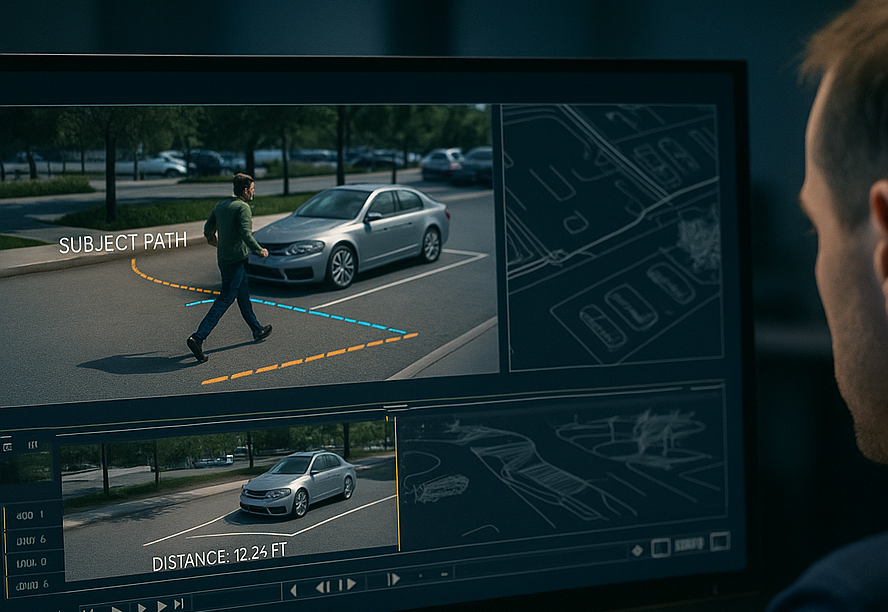
4D Forensics creates annotated media, synchronized timelines, 3D scene views, camera overlays, demonstrative animations, and virtual walkthroughs that remain tied to the underlying evidence and clearly identify any assumptions.
FORENSIC VISUALIZAT-ION
Forensic visualization turns technical findings, measurements, timelines, and digital evidence into clear exhibits that help attorneys, judges, and juries understand the case.
4D Forensics creates annotated media, synchronized timelines, 3D scene views, camera overlays, demonstrative animations, and virtual walkthroughs that remain tied to the underlying evidence and clearly identify any assumptions.
FORENSIC VISUALIZATION
Forensic visualization turns technical findings, measurements, timelines, and digital evidence into clear exhibits that help attorneys, judges, and juries understand the case.
4D Forensics creates annotated media, synchronized timelines, 3D scene views, camera overlays, demonstrative animations, and virtual walkthroughs that remain tied to the underlying evidence and clearly identify any assumptions.
PRESERVED SOURCE EVIDENCE
We work from original or native exports for the best possible analysis.
DEFINED FORENSIC SCOPE
Focused questions and testing that match your legal needs.
CLEAR FINDINGS & LIMITATIONS
Results that explain what the data does and does not support.
LITIGATION SUPPORT
Reports, exhibits, and expert testimony that hold up in court.
What Forensic Visualization can communicate
- The sequence and timing of an incident
- The relationship between several camera views
- The location of people, vehicles, objects, and evidence
- A vehicle path or movement sequence
- A witness or camera line of sight
- Scene measurements and spatial relationships
- A shooting or ballistic trajectory
- The difference between competing event interpretation.
- Technical findings from video, image, audio, or metadata analysis
- The source and basis for an expert opinion
A visual should make the evidence easier to understand, not more dramatic. Every important element should be traceable to a source, measurement, expert analysis, or clearly labeled assumption.
Forensic Visualizations That Bring Evidence to Life
3D SCENE RECONSTRUCTIONS
ANIMATIONS & DEMONSTRATIVES
ACCURATE MEASUREMENTS
POINT CLOUD VISUALIZATION
MULTIMEDIA INTEGRATION
COURTROOM-READY EXHIBITS
A picture may be worth a thousand words, but an accurate 3D visualization can be worth a verdict.
Our forensic visualizations are scientifically accurate, visually compelling, and tailored to communicate your keys facts with clarity and impact.
How The Visualization Process Works
1. Identify The Teaching Objective
We begin with the fact the legal team needs to explain. The visual should answer a defined question rather than display every piece of evidence at once.
2. Establish The Evidence Foundation
Source media, measurements, reports, testimony, scans, photographs, and data are organized. Each proposed visual element is assigned a source or identified as illustrative.
3. Build and Review The Exhibit
Draft visuals are created for technical review. Timing, scale, labels, camera views, and evidence are checked before presentation formatting is finalized.
4. Prepare for Trial, Deposition, or Hearing
The final deliverables can be formatted for courtroom screens, presentation software, video playback, printed boards, expert reports, or attorney-controlled exhibits.
1. Identify The Teaching Objective
We begin with the fact the legal team needs to explain. The visual should answer a defined question rather than display every piece of evidence at once.
2. Establish The Evidence Foundation
Source media, measurements, reports, testimony, scans, photographs, and data are organized. Each proposed visual element is assigned a source or identified as illustrative.
3. Build and Review The Exhibit
Draft visuals are created for technical review. Timing, scale, labels, camera views, and assumptions are checked before presentation formatting is finalized.
4. Prepare for Trial, Deposition, or Hearing
The final deliverables can be formatted for courtroom screens, presentation software, video playback, printed boards, expert reports, or attorney-controlled exhibits.
1. Scope the Claim
We identify what is being asserted about the media, such as originality, continuity, source, date, device, editing history, or synthetic generation.
2. Preservation & Evaluation
The submitted files are documented. Technical properties, hash values when appropriate, metadata, codecs, dimensions, timing, and file relationships are recorded.
3. Examine Consistencies
The analysis may include file structure, encoding sequences, frame or sample timing, compression history, waveform and spectral continuity, metadata relationships, pixel behavior, lighting and shadow relationships, and comparison with known files.
4. Findings & Presentations
The report explains the observations, interpretations, alternative explanations, and limits. Findings may support consistency, inconsistency, evidence of modification, or an inconclusive result.
What You May Receive
- Annotated video or image exhibits
- Synchronized multi-source timelines
- 3D scene renderings and camera views
- Virtual walkthroughs and flythroughs
- Movement, crash, or shooting demonstratives
- Measurement and trajectory graphics
- Courtroom-ready video or presentation files
- Expert explanation and testimony support
Forensic Visualization Accuracy & Fairness Controls
A visualization should not imply a level of certainty that the evidence does not support. Timing ranges, disputed positions, estimated movement, and alternative scenarios should be shown honestly. Camera lenses, perspective, playback speed, and scale must be treated carefully because they can affect how a viewer perceives distance and motion.
Frequently Asked Questions About Forensic Visualization
What is the difference between 3D forensics and forensic visualization?
3D forensics focuses on measurable reconstruction and spatial analysis. Forensic visualization focuses on communicating evidence and expert findings. They often overlap and both are used to present accurate data in a way the trier of fact can best undertsand the event.
Can you create an animation from witness testimony?
A demonstrative may incorporate testimony, but disputed or unverified details should be identified. The legal team and expert must decide whether the animation fairly represents the evidence and how it will be offered.
Can several videos and records be shown on one timeline?
Yes, when shared reference events, timestamps, or other reliable timing information are available. Any clock offsets or timing uncertainty should be stated.
Can the visual be revised as the case develops?
Yes. A staged review process is recommended so that factual changes, rulings, new evidence, and attorney strategy can be incorporated before final production.
Forensic Visualization Analytical Specialties
Forensic visualization transforms raw data into powerful, courtroom-ready visuals that clarify what happened and how. We create scientifically grounded animations, reconstructions, and annotated media that help juries and investigators see the story the evidence tells. Whether you're demonstrating a subject's movement, a vehicle's path, or the layout of a scene, our visualizations are built with precision and purpose.
- 3D Scene Visualization and Modeling
- 3D Modeling of Scenes, Objects, and Environments
- Drone Mapping for Aerial Perspective and Terrain Accuracy
- Motion Tracking to Align Events with Visual Evidence
- Multi-Source Synchronization of Video, Audio, and Data Streams
- Defensible and Accurate Demonstratives for Courtroom Presentation
- Real Measurements for Scale, Distance, and Trajectory Validation
- Validated Forensic Methods Ensuring Scientific Reliability
- Vehicle and Crash Simulation and Animation
- Shooting Incident Simulation and Animation
- Scale and Distance Measurement
- Virtual Walkthroughs and Flythroughs
- Evidence Placement and Spatial Alignment
- Integration of Video Evidence into 3D Models
- Aerial Mapping and Terrain Modeling
- Animation of Events for Courtroom Presentation
- Metadata Integration into 3D Models and Visual Timelines
These visuals are designed to support expert testimony, strengthen legal arguments, and ensure complex evidence is presented clearly and effectively.
