
FORENSIC VIDEO, IMAGE, & AUDIO ENHANCEMENT
Forensic enhancement improves the visibility or intelligibility of recorded evidence while preserving the submitted source and documenting the processing applied.
4D Forensics enhances video, audio, and still images for legal and investigative review, with careful attention to source quality, processing artifacts, and the difference between clarifying recorded information and creating an unsupported interpretation.
FORENSIC VIDEO, AUDIO, & IMAGE ENHANCEME-NT
Forensic enhancement improves the visibility or intelligibility of recorded evidence while preserving the submitted source and documenting the processing applied.
4D Forensics enhances video, audio, and still images for legal and investigative review, with careful attention to source quality, processing artifacts, and the difference between clarifying recorded information and creating an unsupported interpretation.
FORENSIC VIDEO, AUDIO, & IMAGE ENHANCE-MENT
Forensic enhancement improves the visibility or intelligibility of recorded evidence while preserving the submitted source and documenting the processing applied.
4D Forensics enhances video, audio, and still images for legal and investigative review, with careful attention to source quality, processing artifacts, and the difference between clarifying recorded information and creating an unsupported interpretation.
PRESERVED SOURCE EVIDENCE
We work from original or native exports for the best possible analysis.
DEFINED FORENSIC SCOPE
Focused questions and testing that match your legal needs.
CLEAR FINDINGS & LIMITATIONS
Results that explain what the enhancment can and cannot support.
LITIGATION SUPPORT
Reports, exhibits, and expert testimony that hold up in court.
What Forensic Enhancement is Designed To Do
Enhancement can make relevant information easier to inspect, hear, compare, or present. It may reduce visual noise, stabilize motion, correct exposure, isolate an audio frequency range, improve speech audibility and intelligibility, correct perspective, or prepare a clearer demonstrative exhibit.
VIDEO ENHANCEMENT
- Improve visibility in dark or low-contrast footage.
- Stabilize camera movement.
- Reduce compression noise and distracting artifacts.
- Correct aspect ratio, orientation, or playback issues.
- Slow or isolate an event without changing source timing.
- Select and clarify relevant frames.
- Highlight a subject, object, movement, or region of interest.
AUDIO ENHANCEMENT
- Reduce steady hum, hiss, static, or environmental noise.
- Improve speech audibility.
- Balance channels or weak levels.
- Reduce selected interfering frequencies.
- Clarify a relevant sound event.
- Prepare controlled comparison versions for review.
IMAGE ENHANCEMENT
- Improve contrast, brightness, and color balance.
- Reduce noise and compression artifacts.
- Correct perspective or geometric distortion.
- Restore faded or degraded images.
- Enlarge and isolate a region of interest.
- Prepare annotated or comparison exhibits.
Enhancement is not authentication. It does not by itself determine whether a file is original or edited. Enhancement is also not identification. A clearer image or recording may support further comparison, but the source must contain enough reliable information for the requested conclusion.
How The Enhancement Process Works
1. Feasibility Review
We examine the best available source and the requested detail. This step helps determine whether processing is likely to improve the evidence and whether additional source material is needed.
2. Preservation & Evaluation
The submitted file is preserved and documented. Processing is performed on controlled working copies so the original remains available for comparison.
3. Controlled Processing
Techniques are selected for the specific recording. Several versions may be tested to balance clarity with the risk of introducing artifacts or masking relevant information.
4. Comparison & Delivery
The result is reviewed against the source. Deliverables may include the original reference, one or more enhanced versions, selected excerpts or frames, annotated exhibits, and a written explanation of the processing.
1. Feasibility Review
We examine the best available source and the requested detail. This step helps determine whether processing is likely to improve the evidence and whether additional source material is needed.
2. Preservation & Evaluation
The submitted file is preserved and documented. Processing is performed on controlled working copies so the original remains available for comparison.
3. Controlled Processing
Techniques are selected for the specific recording. Several versions may be tested to balance clarity with the risk of introducing artifacts or masking relevant information.
4. Comparison & Delivery
The result is reviewed against the source. Deliverables may include the original reference, one or more enhanced versions, selected excerpts or frames, annotated exhibits, and a written explanation of the processing.
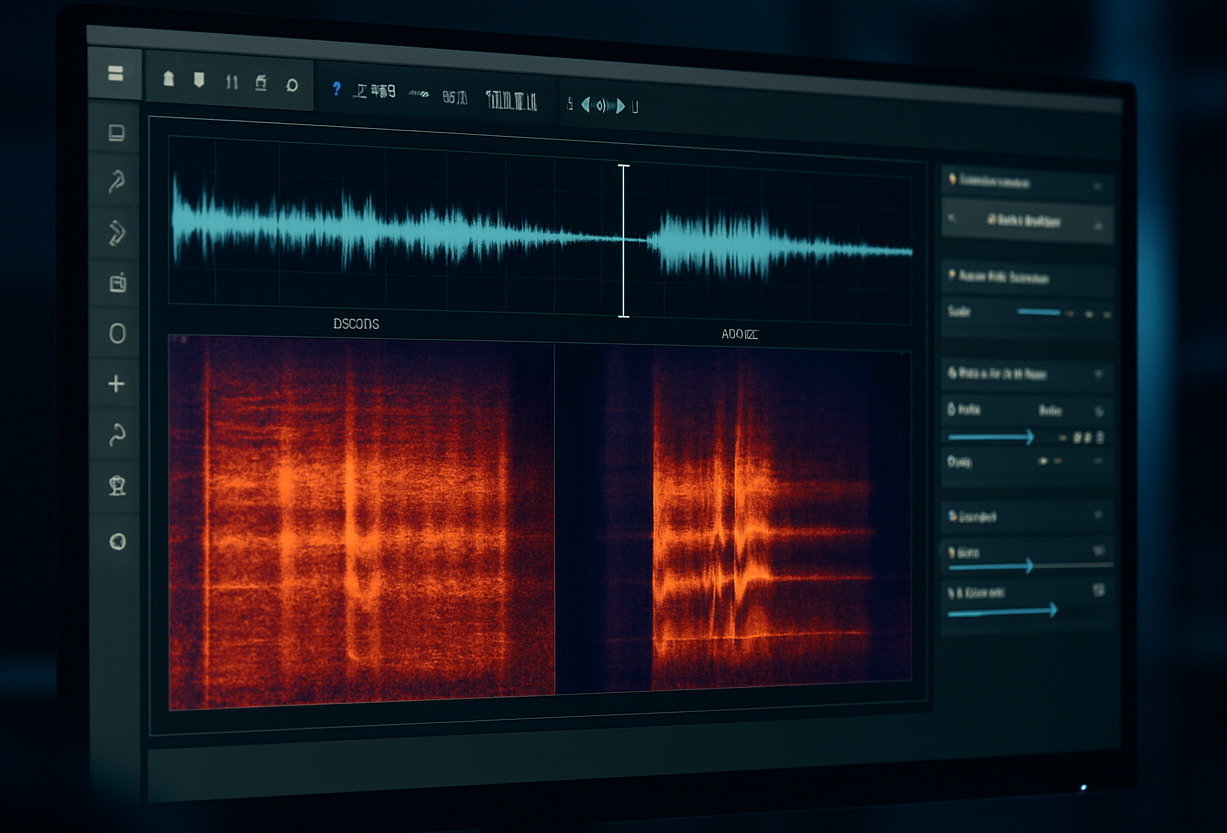
What You May Receive
- Enhanced media in a practical review or presentation format
- Side-by-side source and processed comparisons
- Selected clips, frames, or audio excerpts
- Annotated regions of interest
- A processing log or written method description
- An expert report or testimony when required
The Limits of Enhancement
Enhancement can improve presentation and analysis of information already present. It cannot guarantee recovery of a face, plate, word, reflection, or sound that was not recorded with sufficient quality. Upscaling may improve display and edge visibility, but it does not convert an insufficient source into an original high-resolution recording.
Frequently Asked Questions About Enhancement
Can you tell me in advance whether enhancement will work?
A preliminary review can usually identify the main limitations and whether useful improvement appears possible. Final results cannot be promised before testing the best available source.
Should I enhance the file myself before sending it?
Keep any version you have already created, but also preserve and send the unprocessed original. Consumer editing tools may change metadata, scaling, timing, compression, or the signal itself.
Will the enhanced version replace the original evidence?
No. The original should remain preserved. The enhanced version is a derived work product used to assist examination or presentation and should be traceable to the source.
Is enhancement the same as using generative AI?
No. Forensic enhancement should be controlled, documented, and evaluated against the source. Generative tools can create plausible detail that was not recorded and should not be presented as recovered evidence.
From pixel-level image refinement to spectral noise reduction and frame stabilization, we help legal professionals and investigators uncover the truth hidden in the noise — accurately, responsibly, and transparently.
