
AUDIO FORENSIC
EXPERT SERVICES
Audio evidence may contain speech, background sounds, timing information, or recording artifacts that are difficult to assess through ordinary listening.
4D Forensics examines audio from phones, interviews, surveillance systems, emergency calls, body cameras, voicemails, and other sources to improve intelligibility, evaluate integrity, analyze sound events, and explain the limits of the recording.
AUDIO FORENSIC
EXPERT SERVICES
Audio evidence may contain speech, background sounds, timing information, or recording artifacts that are difficult to assess through ordinary listening.
4D Forensics examines audio from phones, interviews, surveillance systems, emergency calls, body cameras, voicemails, and other sources to improve intelligibility, evaluate integrity, analyze sound events, and explain the limits of the recording.
AUDIO FORENSIC
EXPERT SERVICES
Audio evidence may contain speech, background sounds, timing information, or recording artifacts that are difficult to assess through ordinary listening.
4D Forensics examines audio from phones, interviews, surveillance systems, emergency calls, body cameras, voicemails, and other sources to improve intelligibility, evaluate integrity, analyze sound events, and explain the limits of the recording.
PRESERVED SOURCE EVIDENCE
We work from original or native exports for the best possibly analysis.
DEFINED FORENSIC SCOPE
Focused questions and testing that match your legal needs.
CLEAR FINDINGS & LIMITATIONS
Results that explain what the audio does and does not support.
LITIGATION SUPPORT
Reports, exhibits, and expert testimony that hold up in court.
When Audio Forensic Analysis Can Help
Forensic audio examination can support a legal or investigative matter when:
- Speech is obscured by noise, distance, reverberation, or competing sounds.
- A word, phrase, speaker, or sound event is disputed.
- The timing between sounds is important.
- A recording may have been edited, interrupted, overdubbed, or re-encoded.
- Background noise changes raise questions about continuity.
- Several audio and video sources need to be aligned.
- The legal team needs a technical explanation of what the recording can support.
With audio, the analysis and process must be done carefully. Too aggressive of processing can make a recording actually sound less clear while also introducing distortion or changing how a listener interprets it.
At 4D Forensics, our analysis documents the processing and preserves an unaltered reference.
Audio Sources We Examine
SMARTPHONE RECORDINGS
VOICEMAIL/PHONE
RECORDINGS
911 & DISPATCH AUDIO
BODY-WORN CAMERA AUDIO
INTERVIEW RECORDINGS
SURVEILLANCE SYSTEM AUDIO
MEETING RECORDINGS
DIGITAL
RECORDER
SOCIAL MEDIA APP RECORDINGS
AUDIO EMBEDDED IN VIDEO FILES
The original file is preferred. A recording that has been played through a speaker and captured again may lose frequency detail, timing information, metadata, and useful device and acoustic characteristics.
How an Audio Examination Works
1. Define the Disputed Issue
We identify the exact question, relevant time range, voices or sound events of interest, and whether the requested work involves enhancement, authentication, timing, synchronization, or another form of analysis that will help you.
2. Assess the Recording
The file is evaluated for format, codec, sample rate, channel structure, metadata, signal level, clipping, background conditions, and evidence of conversion or processing.
3. Processing & Analysis
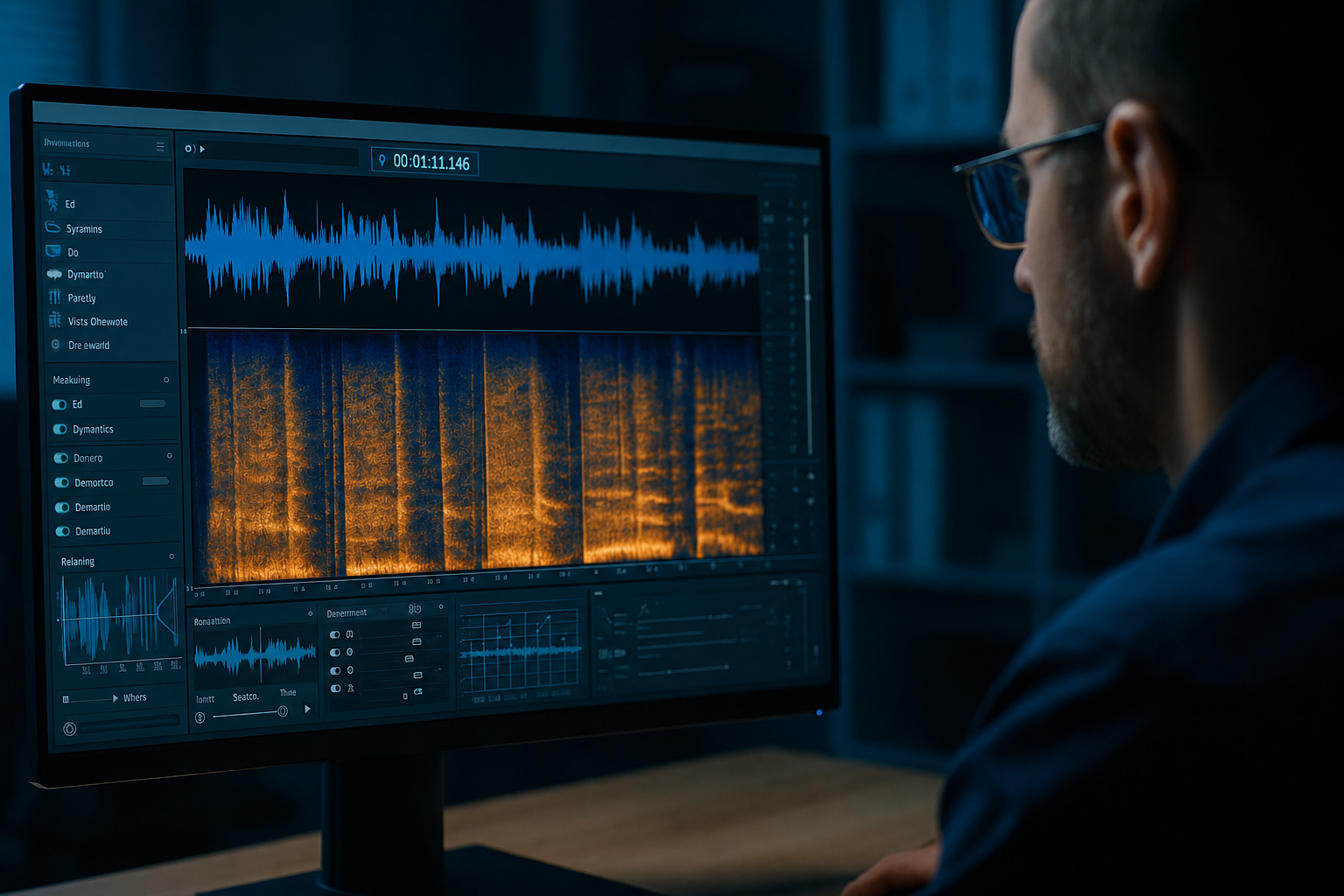
The examination may include frequency filtering, noise reduction, channel separation, spectral review, waveform analysis, level adjustment, timing analysis, or comparison of acoustic conditions. Processing is applied in a controlled manner and evaluated for unintended artifacts.
4. Report the Findings
The work product may include a clarified audio file, selected excerpts, synchronized media, visual waveform or spectrogram exhibits, a written results and conclusions report, and expert support.
1. Define the Disputed Issue
We identify the exact question, relevant time range, voices or sound events of interest, and whether the requested work involves enhancement, authentication, timing, synchronization, or another form of analysis that will help you.
2. Assess the Recording
The file is evaluated for format, codec, sample rate, channel structure, metadata, signal level, clipping, background conditions, and evidence of conversion or processing.
3. Processing & Analysis
The examination may include frequency filtering, noise reduction, channel separation, spectral review, waveform analysis, level adjustment, timing analysis, or comparison of acoustic conditions. Processing is applied in a controlled manner and evaluated for unintended artifacts.
4. Report the Findings
The work product may include a clarified audio file, selected excerpts, synchronized media, visual waveform or spectrogram exhibits, a written results and conclusions report, and expert support.
What You May Receive
- Clarified audio prepared from a documented working copy
- A written report describing methods, findings, and potential limitations
- Time-based exhibits showing relevant sound events
- Synchronized audio and video sources
- Comparative listening files when different processing levels are useful
- Technical consultation, deposition support, or testimony
What Audio Enhancement Cannot Do
Audio enhancement cannot guarantee that every word will become intelligible. A microphone cannot record detail that never reached it, and strong noise, clipping, low data rates, distance, echo, and overlapping voices may permanently mask parts of the signal.
A responsible examination distinguishes between clearly audible content, possible interpretations, and content that cannot be resolved. The result should not be presented with greater certainty than the recording supports.
Frequently Asked Questions About Audio Forensics
Can background noise be completely removed?
Usually not without affecting the wanted sound. The goal is to reduce distracting components while preserving speech or other relevant information. The amount of improvement depends on how strongly the noise overlaps the frequencies and timing of the wanted signal.
Can overlapping voices be separated?
Sometimes partial separation is possible, especially when voices occupy different channels, positions, or frequency ranges. When speakers overlap closely in the same recording channel, complete separation may not be possible.
Can you determine whether an audio file was edited?
An authentication examination can evaluate file structure, metadata, waveform continuity, spectral changes, background consistency, and encoding behavior. Findings must be interpreted in light of how the recording was created, stored, exported, and transmitted.
Can you identify a gunshot or weapon from a recording?
We can examine acoustic events, timing, echoes, recording conditions, and consistency with available evidence. The recording alone may not support identification of a specific weapon. Any opinion must be limited to the characteristics that can be measured and reliably interpreted.
Audio Analytical Specialties
From voicemail threats to interview recordings, audio evidence plays a crucial role in many investigations. Our audio forensic services include clarification, enhancement, analysis, and authentication. We use advanced spectral tools to isolate speech, remove background noise, and identify key phrases or sound events without compromising evidentiary integrity.
- Noise Reduction of Background Hiss, Hum, and Static
- Speech Isolation and Clarification
- Volume Leveling and Signal Amplification
- Frequency Filtering to Remove Interference
- Separation of Overlapping Voices or Sounds
- Forensic Audio Restoration of Damaged Recordings
- Authentication Analysis for Edits, Splices, or Tampering
- Acoustic Environment Consistency Testing
- Anomaly Isolation & Analysis
- Timing Analysis, Adjustments & Synchronization
- Gunshot Identification & Analysis
- Spectral and Waveform Analysis for Detailed Examination
Whether it’s clarifying a whispered phrase or validating the authenticity of a digital recording, we deliver clear, defensible results.
