
3D FORENSIC RECONSTRUCTION SERVICES
3D forensic reconstruction converts scene measurements, laser scans, photographs, video, drone imagery, and other case data into a measurable spatial model.
4D Forensics uses these models to evaluate distance, position, line of sight, camera perspective, movement, trajectory, and the relationship between people, vehicles, objects, and the surrounding environment.
3D FORENSIC RECONSTRU-CTION SERVICES
3D forensic reconstruction converts scene measurements, laser scans, photographs, video, drone imagery, and other case data into a measurable spatial model.
4D Forensics uses these models to evaluate distance, position, line of sight, camera perspective, movement, trajectory, and the relationship between people, vehicles, objects, and the surrounding environment.
3D FORENSIC RECONSTRUCTION SERVICES
3D forensic reconstruction converts scene measurements, laser scans, photographs, video, drone imagery, and other case data into a measurable spatial model.
4D Forensics uses these models to evaluate distance, position, line of sight, camera perspective, movement, trajectory, and the relationship between people, vehicles, objects, and the surrounding environment.
MEASURABLE SCENE MODELS
We build from reliable data to protect integrity.
DEFINED FORENSIC SCOPE
Focused questions and testing that match your legal needs.
CLEAR FINDINGS & LIMITATIONS
Results that explain what the reconstruction does and does not show.
LITIGATION SUPPORT
Reports, exhibits, and expert testimony that hold up in court.
When a 3D Reconstruction Can Help
A 3D model is useful when the location and relationship of evidence are central to the dispute. Common applications include:
- Motor vehicle and pedestrian incidents
- Premises liability and visibility questions
- Shooting and ballistic trajectory analysis
- Police use-of-force and critical incidents
- Industrial and workplace accidents
- Crime scene documentation and review
- Witness line-of-sight evaluation
- Camera position and field-of-view analysis
- Distance, scale, clearance, and spatial comparison
- Alignment of video evidence with the physical scene
Source Material Used in 3D Analysis
LASER SCANS & POINT CLOUDS
PHOTO-GRAMMETRY
DRONE IMAGERY
& MAPPING
SCENE VIDEO & PHOTOGRAPHS
SURVEY & SCENE MEAUSUREMENTS
VEHICLE PHOTOS
& DIMENSIONS
ARCHITECTURE
& CAD/BIM FILES
CAMERA DATA
& LOCATIONS
MAPS, DIAGRAMS
& EVIDENCE
SURVEILLANCE CAMERAS
Not every source has the same accuracy. The model should identify which dimensions are measured, which are derived, and which are illustrative.
How the Reconstruction Works
1. Define Spatial Question
We identify the fact that needs to be evaluated, such as visibility, distance, position, trajectory, camera perspective, speed, movement, or consistency with a witness account.
2. Review Source Data
Available scans, photographs, measurements, video, diagrams, and records are evaluated for scale, coordinate relationships, completeness, and uncertainty.
3. Build/Validate the Model
The scene is modeled using the best available data. Known measurements and reference points are used to test scale and alignment. Video or photographs may be camera-matched to the model to evaluate viewpoint and spatial relationships.
4. Findings & Presentations
The resulting model can support measurements, still views, line-of-sight studies, camera overlays, trajectories, movement paths, virtual viewpoints, and demonstrative animations.
1. Define Spatial Question
We identify the fact that needs to be evaluated, such as visibility, distance, position, trajectory, camera perspective, speed, movement, or consistency with a witness account.
2. Review Source Data
Available scans, photographs, measurements, video, diagrams, and records are evaluated for scale, coordinate relationships, completeness, and uncertainty.
3. Build/Validate the Model
The scene is modeled using the best available data. Known measurements and reference points are used to test scale and alignment. Video or photographs may be camera-matched to the model to evaluate viewpoint and spatial relationships.
4. Findings & Presentations
The resulting model can support measurements, still views, line-of-sight studies, camera overlays, trajectories, movement paths, virtual viewpoints, and demonstrative animations.
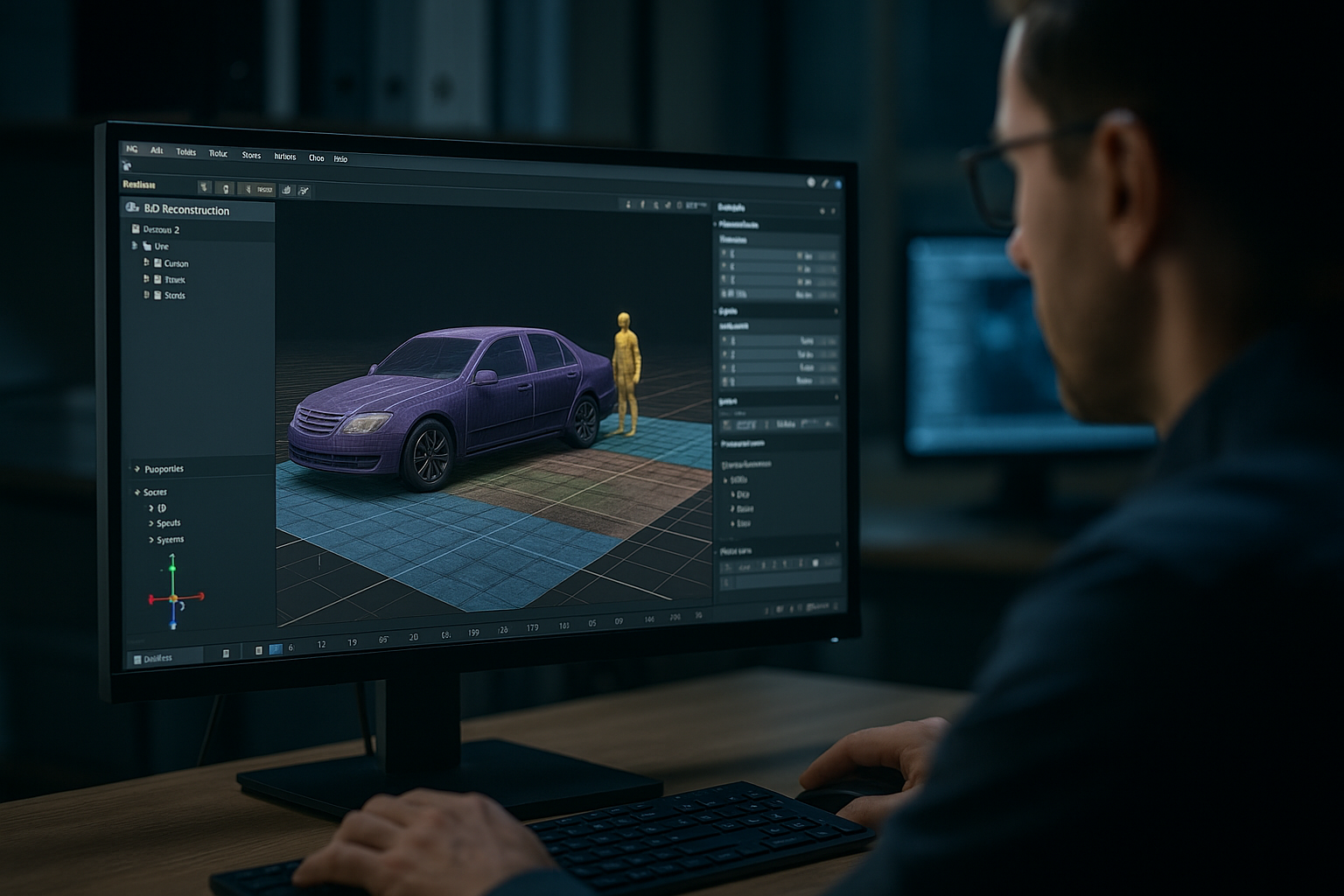
What You May Receive
- A measurable 3D scene or digital twin
- Point cloud and scene alignment views
- Distance, height, clearance, and position measurements
- Witness or camera line-of-sight exhibits
- Camera match overlays
- Trajectory or movement path exhibits
- Still renderings, video sequences, or interactive review
- A written report and expert support
3D Forensic Accuracy, Assumptions, and Limitations
A 3D reconstruction is only as reliable as the source data and the methods used to relate that data. Missing measurements, changed scene conditions, uncertain camera locations, lens distortion, incomplete scans, and undocumented object positions can affect the result.
Every significant assumption should be identified. Analytical views should distinguish measured geometry from illustrative content. A strong model does not hide uncertainty. It shows the court and legal team where the evidence is precise and where a range or limitation is required.
Frequently Asked Questions About 3D Forensics
Do you need to scan the scene in person?
An on-site scan may provide the strongest spatial record, but a reconstruction can sometimes be developed from existing point clouds, photographs, video, surveys, plans, or measurements. The available source material determines the level of accuracy.
Can video be placed inside a 3D model?
Yes, when the scene geometry and camera position can be established. Video-to-3D alignment can help evaluate field of view, apparent movement, distance, and the relationship between the camera image and the physical environment.
Is a 3D model evidence or only a demonstrative?
That depends the foundation of the supported data, how it is created, and ultimately used. The model may contain analytical measurements and may also be used to create demonstrative views. We work with the legal team to determine how the work will be presented, and how we help to ensure admissibility in court.
Can the model show what a witness could see?
A line-of-sight or perspective study can evaluate the geometric view from a documented position and height. It cannot determine attention, perception, memory, or what a person actually saw, only what was avaialble to be seen.
3D Analytical Specialties
3D forensics involves capturing, modeling, and analyzing real-world environments in three dimensions for accurate spatial analysis. We use 3D laser scanning, photogrammetry, LiDAR, and drone mapping to create measurable reconstructions of scenes such as crime scenes, crash sites, and incident locations.
- 3D Laser Scanning and Point Cloud Analysis
- Scene Preservation for Accurate Documentation
- Spatial Analysis of Person and Object Relationships
- Photogrammetry-Based Reconstruction
- Camera Match Overlay and Video-to-3D Alignment
- Witness Line-of-Sight Analysis and Determination
- Precise Measurements for Scale and Validation
- Speed and Trajectory Analysis
- Vehicle and Crash Reconstruction
- Ballistic Trajectory and Shooting Reconstruction
- 3D Scene Forensic Visualization and Modeling
- Integration of Video Evidence into 3D Models
The result is a scientifically accurate digital twin that can be explored, analyzed, and presented to investigators, attorneys, and juries. Our 3D models are used to support testimony, enhance understanding, and validate or challenge witness accounts.
